What we Carried
I started my company in 2000. I was 17. I built megabus.com in 2003. I was 21.
It started off small, and little by little, I carried more and more. I became we, and we carried more and more. Before we realised, we were carrying a great deal. Ultimately, though, if something went seriously wrong, it would be on my shoulders.
The chart does not capture the scaling of the organisation, or other departments like tech support or hosting, which had dozens of clients.
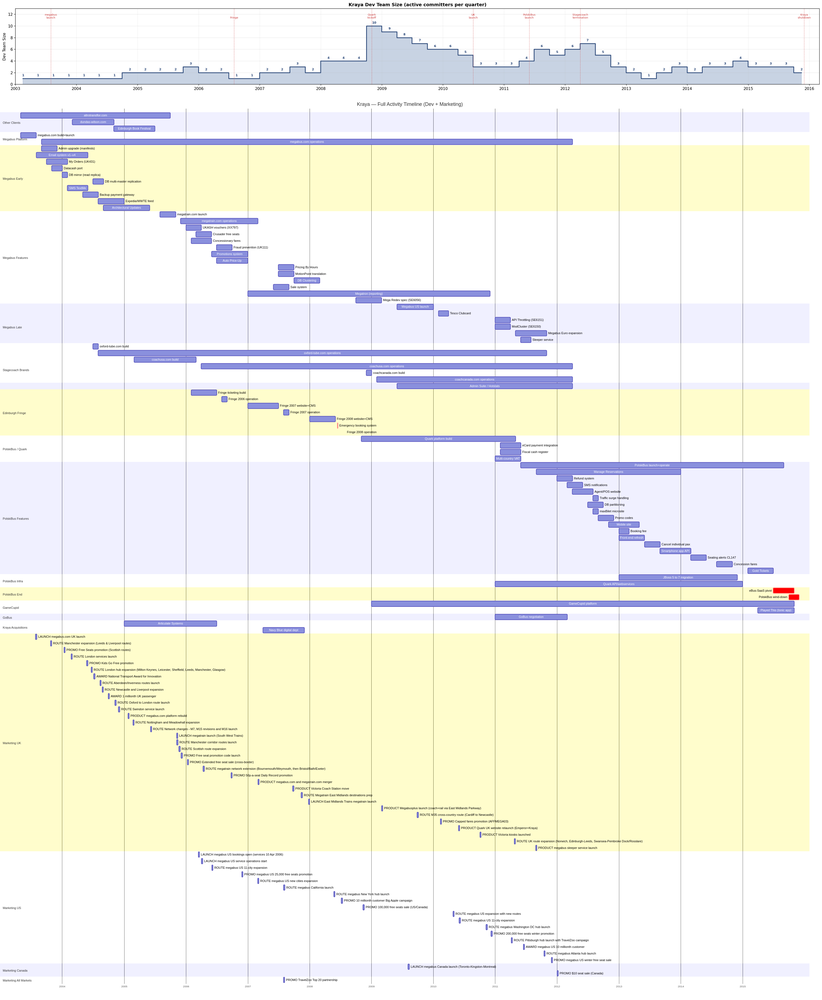
Data mined by Claude from my emails, issue trackers and code repos
The section at the top is the number of active committers for that quarter. You can see my on my todd at the start and the rise and the fall of the dev team.
The very peak of it was in 2008. We built a booking system over the weekend for the Edinburgh festival fringe because their brand new £800k+ system could only handle one person at a time.
There were a handful of us building it while I was simultaneously prepping and managing the megabus US systems for a sales campaign. At the same time we were operating megabus across the UK, USA, and Canada, Oxford Tube, Coach USA, the Fringe website itself and numerous other smaller hosting clients like Boots, Kelloggs Food Service, and so on.
We were a total of ~4 developers and two systems administrators holding all of these together.
I was recently reminded of a story a friend of mine told me. Before he was my friend, he worked with me, and one of the things we did together was one the big megabus deployments when we migrated to a Java EE ticketing system.
One part of the migration was the data. I had developed a tool to migrate the data and on the evening - everything was prepared, we were off peak, and we had taken the site offline. He ran the script, which went on for a wee while and it failed. It was not meant to do that.
The way he tells the story, he told me about the failure. I come over, look at the errors, say “hmmm, that’s interesting,” and head off to have a cigarette. A few minutes later I go over to my desk type away furiously, then asked him to run it again.
It worked, and completed.
I remember that night. I don’t remember what the problem was or how I fixed it, but I do remember that moment when I went over to see how it had failed. In the short walk from my desk to his, I reiterated in my mind, all the possible backup plans - with the worst case scenario being to call off the migration on that day. We would do it another day. It would cost money, but it would be do-able. I was ok with that.
I was curious as to where my limits were, so I kept pushing, until I would meet with a wall.
There were no rails and there were no railings - just a cliff edge, unmarked… I didn’t know that - I expected a brick wall.
The worst of it would be only a few years later, in 2011. We built a new Java EE ticketing system for a fraction of what it should have cost in about 30% of the time it needed.
I personally responded to over 250 out of hours emergency tickets over an 18 month period. That was hard!
I had run off a cliff edge, and like the roadrunner in the cartoons, it took a while before I realised there was no ground beneath me.
A few years after I ran off the cliff, the company shut down. A few years later, I would start my active recovery journey through therapy. A few years later still, when I felt ready for a leadership role, I was asked to lead a problematic team - a role they struggled to fill for a while.
The team worked hard and delivered but struggled with the perception of poor delivery. Trust was thin, stress was high and morale was low. The situation was so bad that the week before I was supposed to start, the scrum master who was supposed to be my guide through it all quit.
I was warned by multiple people that this job was loaded with problems. I took on the job anyway, without a real guide, straight into multiple serious issues.
I loved it and managed to turn the whole thing around in my first week. Delivered key items, laid the foundations of trust and improved morale. It took a bit longer to bed everything down. Within weeks, I was asked if I would take on leading the entire digital team.
It was here, many years later, I got a sense of how unusual it was for such a tiny team to do so much.
It was here, many years later, I got a sense of how it is to have guardrails, to have support, peers to lean on.
It was here, for the first time I realised that the job didn’t have to be a lonely one.